Single-Player vs Multiplayer Games: Which Gaming Experience Is Better?
Gaming offers countless ways to have fun, but one of the biggest choices players face is whether to spend their time with single-player games or multiplayer games. Both types of gaming experiences have their own advantages, challenges, and unique appeal. Some players love getting lost in a detailed story and exploring a virtual world at their own pace, while others enjoy competing or cooperating with real players from around the world.
In 2026, the difference between single-player and multiplayer gaming has become even more interesting. Modern games can offer cinematic storytelling, enormous open worlds, competitive online modes, cooperative adventures, live events, and constantly updated content. Choosing between them often depends on your personality, available time, preferred gaming style, and what you expect from a game.
So, single-player vs multiplayer games—which gaming experience is better? The answer depends on the player. In this guide, we will compare both experiences across different categories to help you understand which one may be right for you.
1. What Are Single-Player Games?
Single-player games are designed primarily for one person. The player usually controls the main character and progresses through a story, campaign, world, or series of challenges without needing other human players.
These games can focus heavily on storytelling, exploration, puzzles, combat, progression, or a combination of different gameplay elements. Because the experience is controlled by the player, you can usually play at your own pace without worrying about teammates or opponents. This makes single-player games an excellent choice for gamers who prefer a more personal and relaxed experience.
2. What Are Multiplayer Games?
Multiplayer games allow multiple players to interact within the same gaming environment. Depending on the game, players may compete against each other, cooperate as a team, or participate in a larger shared world.
Multiplayer gaming can include competitive shooters, racing games, sports games, MMORPGs, survival games, battle royale titles, strategy games, and cooperative adventures. The biggest advantage is the human element. Instead of playing against computer-controlled characters alone, you interact with real people whose decisions and strategies can change every match.
3. Storytelling Is Often Stronger in Single-Player Games
One of the biggest strengths of single-player gaming is storytelling. Developers can create detailed characters, emotional moments, cinematic scenes, and carefully designed narratives without needing to constantly accommodate competitive multiplayer mechanics.
Players can experience the story at their own pace and become deeply connected to the characters and world. If you enjoy games that feel like interactive movies or long adventures, single-player games can provide an especially satisfying experience.
4. Multiplayer Games Offer Human Competition
Multiplayer gaming provides something that computer-controlled opponents cannot completely reproduce: unpredictable human behavior. Every opponent has different skills, strategies, reactions, and decision-making habits.
This unpredictability makes multiplayer matches exciting. You may face a highly skilled opponent one moment and a completely unexpected strategy the next. For players who enjoy competition and constantly improving their abilities, multiplayer games can offer almost endless challenges.
5. Single-Player Games Let You Play at Your Own Pace
Single-player games are ideal when you do not want to worry about other players. You can pause the game, explore optional areas, change the difficulty, take breaks, or spend extra time completing side missions.
This freedom is particularly useful for gamers with busy schedules. You do not have to worry about teammates waiting for you or opponents gaining an advantage while you are away. You can simply return to the game whenever you have time.
6. Multiplayer Games Are Great for Social Interaction
Multiplayer games can turn gaming into a social activity. Friends can communicate through voice chat, cooperate on objectives, compete against each other, and share memorable moments.
For many players, the social aspect is one of the main reasons they enjoy multiplayer gaming. A simple match can become more entertaining when you are playing with friends. Multiplayer games can also allow players to meet people from different parts of the world and build gaming communities.
7. Single-Player Games Can Provide Better Immersion
Immersion is another major advantage of single-player gaming. When you are the only human player in a carefully designed world, it can be easier to become emotionally invested in the experience.
There are fewer distractions from teammates, voice chat, competitive pressure, or unexpected player behavior. Developers can control the environment and pacing more carefully, allowing them to create atmospheric experiences that focus entirely on the player’s journey.
8. Multiplayer Games Provide Greater Replayability
Multiplayer games can offer enormous replay value because every match can be different. Human opponents do not always behave in predictable ways, meaning the same map or game mode can produce completely different experiences.
Competitive multiplayer games can also encourage players to improve their skills over time. Ranking systems, seasonal content, leaderboards, unlocks, and competitive events can give players reasons to keep coming back.
9. Single-Player Games Usually Have a Clear Progression
Many single-player games provide a structured progression system. You begin with basic abilities, gradually become stronger, unlock new areas, discover equipment, and eventually complete the main storyline.
This progression can feel extremely rewarding because you can clearly see how your character develops. Completing a difficult mission or defeating a powerful enemy can provide a strong sense of accomplishment.
10. Multiplayer Games Can Improve Competitive Skills
Multiplayer gaming can help players develop skills such as reaction time, communication, teamwork, decision-making, map awareness, and strategic thinking.
Competitive games often require players to make decisions quickly while dealing with unpredictable situations. You may need to communicate with teammates, predict an opponent’s movement, manage limited resources, and adapt your strategy during a match.
11. Single-Player Games Are Better for Relaxed Gaming
If you want gaming to be a way to relax after a long day, single-player games can be an excellent choice. You can choose your difficulty, explore the environment, enjoy the soundtrack, and progress without worrying about losing to another player.
There is still plenty of challenge in many single-player games, but the pressure is usually different from competitive multiplayer. You are generally competing against the game’s design rather than another person’s skill level.
12. Multiplayer Games Can Be More Exciting
For players who enjoy adrenaline and unpredictable situations, multiplayer gaming can be more exciting. A match can change completely within seconds because of another player’s decision.
Winning a close competitive match can also create a powerful feeling of achievement. The combination of skill, teamwork, pressure, and unpredictability gives multiplayer games a unique energy that single-player experiences cannot always replicate.
13. Single-Player Games Do Not Require a Stable Internet Connection
Many single-player games can be enjoyed without a constant internet connection, depending on the specific title and platform requirements. This makes them convenient for players who have unreliable internet access or prefer offline gaming.
You can focus entirely on the game without worrying about ping, packet loss, server problems, or connection interruptions. For offline-friendly gaming, single-player experiences have a clear advantage.
14. Multiplayer Gaming Depends More on Internet Quality
Internet performance is much more important for online multiplayer games. A slow connection, high ping, packet loss, or unstable Wi-Fi can negatively affect your experience.
In competitive games, even small delays can make it harder to react quickly. This means multiplayer players may need to pay attention to their network setup, router performance, connection type, and server selection. A stable internet connection can make a major difference.
15. Single-Player Games Can Be More Accessible to Beginners
Single-player games often allow new players to learn at their own pace. Many titles provide tutorials, adjustable difficulty settings, and gradual progression systems.
If you are new to gaming, playing against computer-controlled opponents can sometimes feel less stressful than competing against experienced human players. You can learn the controls, mechanics, and strategies before moving into more competitive experiences.
16. Multiplayer Games Can Have a Steeper Learning Curve
Multiplayer games can be challenging for beginners because experienced players may already understand advanced strategies, maps, mechanics, and team compositions.
A new player may struggle initially, particularly in highly competitive games. However, this challenge can also be motivating. Learning from mistakes, practicing mechanics, and gradually improving your performance can make multiplayer gaming extremely rewarding.
17. Single-Player Games Often Provide More Creative Freedom
Developers have greater freedom to experiment with unusual storytelling, gameplay mechanics, characters, and world design in single-player experiences.
Without the need to balance every mechanic around competitive multiplayer, developers can create unusual abilities, powerful enemies, puzzle systems, cinematic sequences, and experimental gameplay features. This is one reason single-player games can feel very different from one another.
18. Multiplayer Games Focus More on Long-Term Engagement
Many multiplayer games are designed to keep players engaged for months or even years. Developers may introduce new maps, characters, weapons, events, seasons, challenges, and other content.
This ongoing structure can make multiplayer games feel like evolving platforms rather than traditional games with a fixed beginning and ending. For players who enjoy constantly changing experiences, this can be a major advantage.
19. Which Is Better for Competitive Gamers?
If you are highly competitive, multiplayer gaming is usually the better choice. Competitive multiplayer games provide rankings, opponents, tournaments, leaderboards, and opportunities to measure your performance against other players.
You can continuously improve your skills and compete against increasingly difficult opponents. However, competitive gaming can also become stressful, especially when losing streaks or toxic behavior affect the experience. Maintaining a healthy attitude is important.
20. Which Is Better for Story Lovers?
For gamers who primarily care about storytelling, characters, exploration, and emotional experiences, single-player games are generally the stronger choice.
A well-designed single-player campaign can provide dozens of hours of carefully structured content. You can experience the narrative without distractions and take the time to appreciate the game’s world, characters, music, and visual design.
21. Which Is Better for Playing With Friends?
If your main goal is to spend time with friends, multiplayer games have a clear advantage. Cooperative and competitive games allow players to share experiences even when they are physically far apart.
Whether you are working together to complete an objective or competing against each other, multiplayer gaming can create memorable moments. For social gamers, this aspect may be more important than graphics or story.
22. Which Is Better for Short Gaming Sessions?
For short gaming sessions, both types can work, but multiplayer games with quick matches can be particularly convenient. You can join a match, play for a limited period, and stop when you are finished.
Single-player games can also work well if they offer checkpoints and flexible mission structures. The best choice depends on how much uninterrupted time you normally have available.
23. Which Experience Offers Better Value?
Value depends on how you play. A single-player game may provide a large campaign with dozens of hours of content, while a multiplayer game can potentially be played for hundreds or thousands of hours.
If you prefer completing a game and moving on to something new, single-player games may provide better value. If you enjoy playing the same game repeatedly and improving over time, multiplayer games may provide greater long-term value.
24. Can You Enjoy Both Types of Games?
Absolutely. You do not need to choose only one gaming style. Many gamers enjoy both single-player and multiplayer games depending on their mood.
You might spend the weekend exploring a story-driven adventure and then play competitive matches with friends during the week. Having access to both experiences gives you more variety and allows you to choose a game based on how you want to spend your gaming time.
Single-Player vs Multiplayer Games: Quick Comparison
| Feature | Single-Player | Multiplayer |
|---|---|---|
| Storytelling | Excellent | Varies |
| Competition | Limited | Excellent |
| Social interaction | Limited | Excellent |
| Offline gaming | Often available | Usually limited |
| Replayability | Moderate to high | Usually very high |
| Relaxation | Excellent | Depends on game |
| Teamwork | Usually limited | Excellent |
| Skill competition | Against AI/game | Against real players |
| Internet requirement | Often not required | Usually required |
| Long-term updates | Less common | Very common |
| Learning environment | Usually beginner-friendly | Can be challenging |
| Exploration | Often excellent | Depends on game |
Single-Player or Multiplayer: Which One Should You Choose?
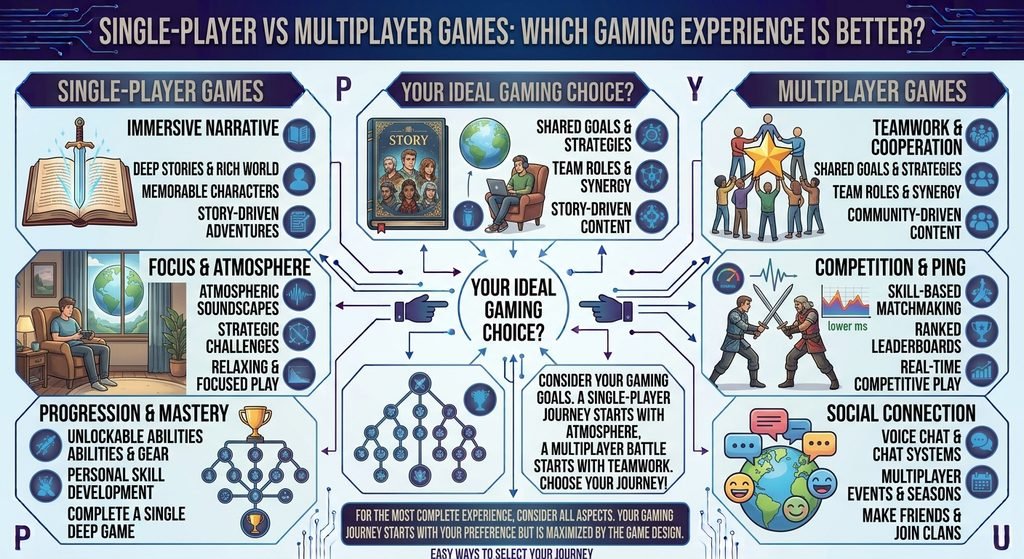
The best choice depends on what you want from gaming. Choose single-player games if you enjoy stories, exploration, immersive worlds, relaxed gameplay, and progressing at your own pace. They are especially good for players who want a personal experience without the pressure of competing against other people.
Choose multiplayer games if you enjoy competition, teamwork, social interaction, unpredictable matches, and continuous improvement. They are ideal for players who want gaming to be a social activity and enjoy testing their skills against real opponents.
Ultimately, there is no universal winner in the single-player vs multiplayer games debate. Both provide unique experiences, and the better option is the one that matches your personal gaming preferences.
Final Thoughts
Single-player and multiplayer games represent two different sides of modern gaming. Single-player experiences can deliver powerful stories, immersive worlds, creative gameplay, and relaxing adventures. Multiplayer games provide competition, teamwork, social interaction, and almost endless replayability.
The good news is that you do not have to choose one permanently. Modern PC gaming offers an enormous variety of both experiences, allowing you to switch between them whenever your preferences change.
If you want to relax and become part of an unforgettable story, pick a single-player game. If you want competition, teamwork, and unpredictable action, jump into multiplayer. The best gaming experience is ultimately the one that gives you the most enjoyment.