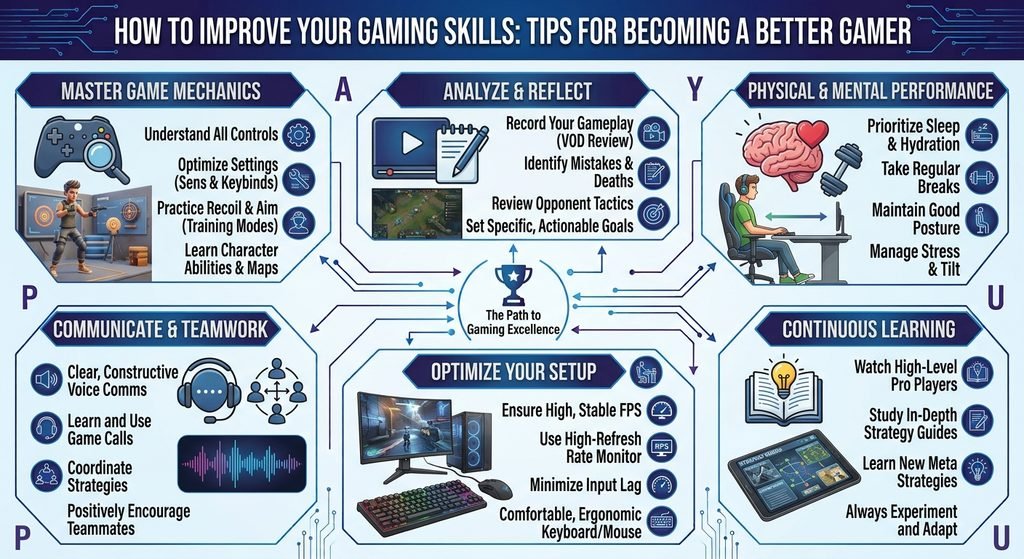
How to Improve Your Gaming Skills: Tips for Becoming a Better Gamer
Gaming is no longer just a way to pass the time. For millions of players around the world, gaming has become a serious hobby, a competitive activity, and even a career. Whether you enjoy first-person shooters, racing games, strategy titles, sports games, battle royale games, or multiplayer adventures, improving your gaming skills can make every session more enjoyable. However, becoming a better gamer does not happen overnight. It requires practice, patience, concentration, and a willingness to learn from mistakes.
Many players believe that professional gamers are simply naturally talented, but skill is often developed through consistent practice and the right approach. You can improve your reaction time, accuracy, decision-making, game knowledge, communication, and overall performance by following effective gaming habits.
In this guide, we will explore some of the best ways to improve your gaming skills and become a more confident and capable gamer.
1. Choose a Game and Focus on Improving
One of the first steps toward becoming a better gamer is choosing a game that you genuinely enjoy and focusing on improving at it. Playing too many different games at the same time can make it difficult to develop advanced skills because every game has different mechanics, controls, maps, strategies, and objectives. When you consistently play one particular game, you begin to understand its systems more deeply and naturally become more comfortable with its controls.
Spend time learning the fundamentals of your chosen game instead of constantly switching between titles. Understand how movement works, learn the maps, study weapons or characters, and discover effective strategies. As your knowledge increases, you will begin making decisions faster because you will recognize situations that you have experienced before. Specializing in one game does not mean you can never play anything else; it simply gives you a clear area in which to develop your skills.
2. Practice Consistently
Consistent practice is one of the most important gaming improvement tips. You do not necessarily need to play for many hours every day. Instead, focus on practicing regularly and intentionally. Even a shorter gaming session can be productive if you have a specific goal.
For example, if you are playing a competitive shooter, you might spend part of your session practicing aiming and recoil control. If you are playing a strategy game, you could focus on improving your opening strategy or resource management. Setting small goals gives your practice sessions a purpose and makes it easier to measure progress. Over time, regular practice helps build muscle memory, improve reaction speed, and make important actions feel more natural.
3. Learn the Game Mechanics
Understanding game mechanics can give you a major advantage over players who simply play without learning how the game works. Every competitive game has systems that influence how players move, attack, defend, upgrade equipment, manage resources, or interact with the environment.
Take some time to study these mechanics carefully. Learn which weapons are effective at different ranges, how character abilities work, which items provide the greatest advantages, or how different strategies affect the outcome of a match. The deeper your understanding becomes, the easier it will be to make smart decisions during gameplay.
Game knowledge can sometimes be just as important as mechanical skill. A player with average aim but excellent decision-making can often outperform someone with fast reflexes but poor game awareness.
4. Improve Your Aim and Accuracy
For players who enjoy shooting games, improving aim is one of the most effective ways to become a better gamer. Accuracy requires coordination between your eyes and hands, and this ability improves through repetition and deliberate practice.
Use practice ranges, aim-training modes, or custom matches whenever they are available. Focus on tracking moving targets, controlling recoil, improving flick shots, and maintaining consistent crosshair placement. Avoid simply shooting randomly; instead, concentrate on making each movement controlled and purposeful.
Your mouse sensitivity or controller sensitivity also plays an important role. Experiment with different settings until you find a configuration that allows you to aim comfortably. Once you find a setting that works, avoid changing it constantly. Consistency allows your muscle memory to develop over time.
5. Work on Your Reaction Time
Fast reactions can be extremely valuable in competitive gaming. Being able to recognize a threat and respond quickly can give you an advantage during intense situations. However, reaction time is not only about having naturally fast reflexes. It can also improve through practice and better awareness.
Instead of waiting until something happens, learn to anticipate what your opponent may do. For example, if you understand common movement patterns or know where an opponent is likely to appear, you can prepare your response before the event occurs. This makes your gameplay feel faster because you are relying on prediction as well as reaction.
Regular gaming practice, reaction-based exercises, and competitive gameplay can gradually improve your ability to respond under pressure.
6. Watch Professional and Experienced Players
One of the easiest ways to learn advanced gaming techniques is to watch players who are better than you. Professional gamers, experienced streamers, and high-level competitive players often demonstrate strategies that casual players may never discover on their own.
Pay attention to how they move, position themselves, manage resources, communicate with teammates, and make decisions. Do not just watch for entertainment. Try to understand why they are making particular decisions.
After watching experienced players, attempt to apply one or two of their techniques in your own matches. You may not immediately perform at the same level, but studying stronger players can help you recognize mistakes and discover better approaches to common situations.
7. Learn From Your Mistakes
Every gamer makes mistakes. Even professional players lose matches and make poor decisions. The difference between players who improve and players who remain at the same level is often how they respond to their mistakes.
Instead of becoming frustrated after losing, ask yourself what went wrong. Did you position yourself badly? Did you rush into a fight without enough information? Did you waste an important ability? Did you fail to communicate with your teammates?
If your game provides replay or match-recording features, review your gameplay when possible. Watching yourself can reveal mistakes that are difficult to notice while you are actively playing. Once you identify a recurring problem, create a specific goal to correct it in future matches.
8. Improve Your Game Awareness
Game awareness is the ability to understand what is happening around you and predict what might happen next. It is one of the most valuable skills in competitive gaming because it allows you to make better decisions before a situation becomes dangerous.
Developing awareness means paying attention to more than what is directly in front of you. Listen for sounds, monitor the game map, track enemy positions, observe your teammates, and remember important information from previous encounters.
Over time, you will start recognizing patterns. You may know when an opponent is likely to attack, when an area is unsafe, or when your team should retreat. Strong awareness allows you to stay one step ahead of your opponents.
9. Use the Right Gaming Equipment
Your equipment can also affect your gaming performance. While expensive hardware does not automatically make someone a better gamer, reliable equipment can help you play more comfortably and consistently.
For PC gaming, a responsive gaming mouse, comfortable keyboard, quality mouse pad, and suitable monitor can improve control and visibility. A good headset can help you hear important audio cues, while a comfortable gaming chair can make long sessions easier.
However, avoid buying equipment simply because it is marketed as professional gaming gear. Choose accessories that match your needs and budget. A comfortable and reliable setup is more important than having the most expensive equipment available.
10. Optimize Your Gaming Settings
Gaming settings can have a significant impact on performance. Graphics settings, sensitivity, field of view, key bindings, audio settings, and display options can all influence your experience.
If your computer struggles to maintain stable frame rates, reducing certain graphics settings may improve performance. A stable frame rate can make gameplay feel smoother and more responsive. Similarly, adjusting mouse sensitivity or controller settings can help you find controls that feel natural.
Do not copy another player’s settings blindly. Professional players have different preferences, equipment, and playstyles. Use their settings as inspiration, but spend time testing different options and finding what works best for you.
11. Communicate With Your Teammates
Communication is essential in team-based multiplayer games. Even if you have excellent individual skills, poor communication can cause your team to lose important matches.
Learn to provide useful information clearly and quickly. Tell teammates where opponents are located, warn them about incoming threats, share important resources, and communicate your plans. Avoid unnecessary arguments or negative comments because they can reduce team morale and concentration.
Good communication is not about talking constantly. It is about delivering useful information at the right time. A calm and cooperative player can often make a significant difference to team performance.
12. Stay Calm Under Pressure
One of the biggest challenges in competitive gaming is maintaining concentration when things go wrong. Losing several matches in a row can be frustrating, and frustration can lead to poor decisions.
When you become angry or overly emotional, your reaction speed, concentration, and decision-making may suffer. If you notice yourself becoming frustrated, take a short break instead of immediately starting another match.
Learning to remain calm allows you to think more clearly during difficult situations. Treat every match as an opportunity to learn rather than as a test of your personal ability. A positive mindset can help you recover from mistakes and continue improving.
13. Take Regular Breaks
Improving your gaming skills does not mean playing continuously for hours without stopping. Regular breaks can help you maintain concentration and reduce physical fatigue.
After a long session, your reactions and decision-making may become slower even if you do not immediately notice it. Standing up, stretching, drinking water, and resting your eyes can help you return to the game feeling refreshed.
A balanced gaming routine is often more effective than extremely long sessions. Quality practice is more valuable than simply increasing the number of hours you spend playing.
14. Play Different Game Modes
Different game modes can help you develop different skills. Competitive matches may teach decision-making and pressure management, while practice modes can help improve mechanical abilities.
For example, a player can use training modes to practice aiming, casual matches to experiment with strategies, and ranked matches to test those strategies under pressure. Playing different modes prevents your practice from becoming repetitive and exposes you to a wider range of situations.
Use each mode for a specific purpose. This makes your overall training more effective and helps you identify which areas of your gameplay need the most improvement.
15. Set Realistic Gaming Goals
Finally, set realistic goals for your gaming improvement. Becoming a highly skilled player takes time, so expecting dramatic results immediately can lead to unnecessary frustration.
Instead of saying, “I want to become the best player,” create smaller goals such as improving your accuracy, reducing unnecessary deaths, learning a new character, reaching a specific rank, or improving your average performance.
Track your progress over time and celebrate small improvements. When you focus on gradual progress rather than instant results, gaming becomes more enjoyable and your skills can develop naturally.
Final Thoughts
Learning how to improve your gaming skills requires more than simply playing for longer hours. The most effective approach combines consistent practice, game knowledge, better decision-making, strong communication, and a positive mindset.
Focus on one game, learn its mechanics, practice specific skills, study experienced players, and analyze your mistakes. At the same time, make sure your gaming setup is comfortable and take regular breaks to maintain concentration.
Most importantly, remember that improvement takes time. You will lose matches, make mistakes, and experience frustrating moments, but each of these experiences can teach you something valuable. With patience and consistent effort, you can become a more skilled, confident, and knowledgeable gamer.
Whether your goal is to climb the competitive rankings or simply perform better with your friends, these gaming tips for beginners and experienced players can help you take your gameplay to the next level in 2026.