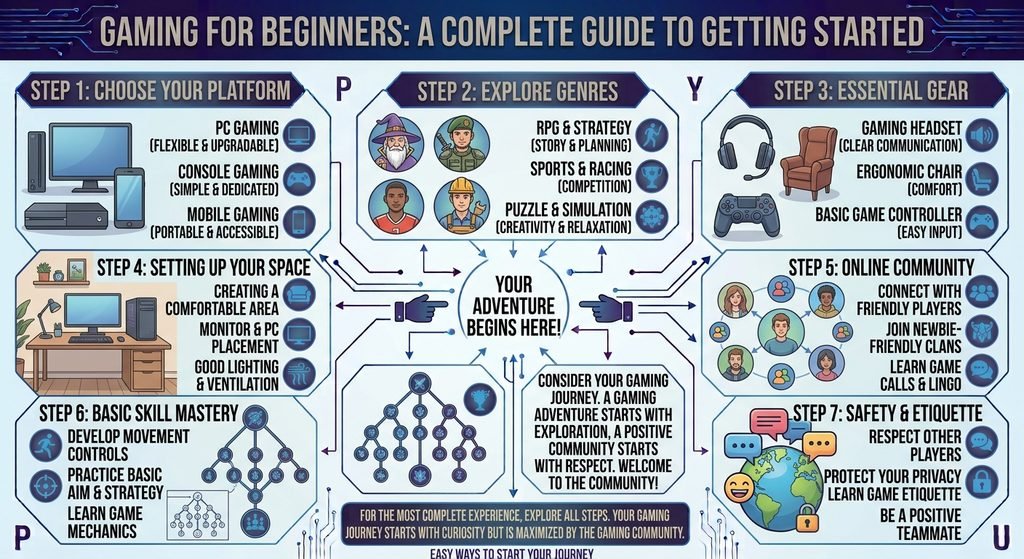
Gaming for Beginners: A Complete Guide to Getting Started
Gaming has become one of the most popular forms of entertainment around the world. From action-packed shooters and racing games to relaxing simulations and story-driven adventures, there is something for almost every type of player. However, if you are completely new to gaming, getting started can feel confusing. There are different platforms, controllers, gaming accessories, genres, settings, and online features to understand.
The good news is that you do not need expensive equipment or advanced skills to become a gamer. You can start with a simple setup, choose games that match your interests, and gradually improve as you gain experience. This complete gaming guide for beginners explains the most important things you need to know before starting your gaming journey.
1. Choose the Right Gaming Platform
The first step for any beginner is deciding where you want to play. The most common gaming platforms are PC, PlayStation, Xbox, Nintendo Switch, and mobile devices. Each platform has different advantages, game libraries, controls, and price ranges.
A gaming PC provides flexibility, customization, and access to a huge collection of games. Consoles are generally easier to set up because you can connect them to a TV and start playing with minimal configuration. Mobile gaming is convenient because you can play almost anywhere, while handheld consoles provide a balance between portability and dedicated gaming features.
There is no single best platform for everyone. Consider your budget, the types of games you want to play, and whether you prefer playing at a desk, on a television, or while traveling.
2. Understand Different Gaming Genres
Before buying or downloading games, it helps to understand the major gaming genres. Popular genres include action, adventure, first-person shooters, role-playing games, racing, sports, strategy, simulation, survival, horror, puzzle, and platform games.
Each genre provides a different experience. If you enjoy competition, you might prefer competitive shooters or sports games. If you love stories and exploration, role-playing and adventure games could be a better choice. Players who enjoy planning and decision-making may prefer strategy games.
Do not feel pressured to play whatever is popular. Start with genres that naturally match your interests. Exploring different genres later can also help you discover new types of games you enjoy.
3. Start With Beginner-Friendly Games
New players should avoid choosing extremely complicated games immediately. Some games have hundreds of mechanics, difficult controls, complicated maps, and competitive communities that can overwhelm beginners.
Instead, look for games that offer tutorials, simple controls, adjustable difficulty levels, and clear objectives. Beginner-friendly games allow you to learn basic gaming skills without feeling frustrated.
Story-based games can be particularly useful because they often introduce mechanics gradually. Many games also include training areas where you can practice movement, aiming, driving, combat, or other skills before entering more difficult sections.
4. Learn the Basic Controls
Understanding basic controls is one of the most important parts of learning how to play video games. On a controller, you will typically use analog sticks for movement and camera control, buttons for actions, and triggers for functions such as shooting or accelerating.
PC games commonly use a keyboard and mouse. The WASD keys are frequently used for movement, while the mouse controls aiming or camera movement in many games. Other keys are assigned to actions such as jumping, crouching, reloading, interacting, or opening menus.
Spend some time practicing controls before worrying about performance. You will naturally become more comfortable with the controls after playing regularly.
5. Practice Movement and Camera Control
Movement and camera control are fundamental gaming skills. Beginners often struggle with controlling their character while simultaneously looking around or performing actions.
Start by practicing simple movements such as walking, running, jumping, turning, and changing direction. If you are using a controller, experiment with the sensitivity settings until the camera feels comfortable.
Do not worry if your movement initially feels slow or awkward. Muscle memory develops through repetition. After enough practice, many basic movements will become automatic, allowing you to focus more on the actual game.
6. Adjust the Difficulty Level
Many modern games allow players to choose different difficulty levels. Beginners should not be afraid to select an easier setting.
Playing on an easier difficulty can help you understand the mechanics, learn enemy patterns, explore the environment, and become familiar with the controls. Once you feel comfortable, you can increase the difficulty for a greater challenge.
Difficulty is not a measurement of whether someone is a “real gamer.” The purpose of gaming is to have fun, so choose the experience that you enjoy.
7. Learn How Tutorials Work
Game tutorials are designed to teach you important mechanics before the main gameplay becomes more complicated. Beginners should pay attention to these sections instead of skipping them immediately.
Tutorials may explain movement, combat, inventory systems, abilities, maps, crafting, quests, or other features. Even experienced players can benefit from tutorials when starting a completely new type of game.
If you forget a control, check the game’s settings or controls menu. Most modern games allow you to review button layouts whenever you need them.
8. Understand Gaming Settings
Gaming settings can significantly affect your experience. On PC, settings such as resolution, graphics quality, shadows, textures, frame rate limits, and motion blur can influence performance and visual quality.
Beginners do not need to understand every advanced setting immediately. Start with the recommended settings provided by the game. You can gradually experiment with individual options as you become more comfortable.
If a game feels slow or produces frequent frame drops, lowering demanding graphics settings may improve performance.
9. Choose the Right Gaming Accessories
You do not need expensive accessories when starting gaming. A basic mouse and keyboard can be enough for PC gaming, while consoles normally include the necessary controller.
As you gain experience, you may want to invest in a gaming mouse, mechanical keyboard, headset, mouse pad, monitor, or controller. However, expensive accessories will not automatically make you a better gamer.
Comfort and reliability should be more important than flashy features. Choose equipment that feels comfortable during longer gaming sessions and works properly with your platform.
10. Learn to Use a Gaming Headset
A headset can improve your gaming experience, especially in multiplayer games. It allows you to hear footsteps, environmental sounds, music, dialogue, and other audio details more clearly.
A headset with a microphone can also make communication with teammates easier. However, beginners should not feel that they need an expensive premium headset. A comfortable headset with clear audio and a usable microphone is enough to get started.
Good audio can also improve immersion in single-player games, especially horror, adventure, and story-focused titles.
11. Start With Single-Player Games
Single-player games can be an excellent introduction to gaming. They allow you to learn controls and mechanics without worrying about competing against experienced players.
You can usually pause the game, explore at your own pace, repeat difficult sections, and adjust the difficulty. This creates a more relaxed learning environment.
Once you become comfortable with basic gaming mechanics, you can move into multiplayer games if you enjoy competition and social interaction.
12. Try Multiplayer Games When You Feel Ready
Multiplayer games allow you to play with or against other people. They can be exciting, competitive, and highly social, but they may also be more difficult for beginners.
Experienced players may know maps, strategies, weapons, characters, and game mechanics that you have never encountered before. Losing matches is therefore completely normal when you are starting.
Focus on learning instead of winning every match. Pay attention to what experienced players do and gradually improve your own decision-making.
13. Learn From Your Mistakes
Making mistakes is one of the fastest ways to improve at gaming. You may miss an important shot, make a poor decision, fall into a trap, lose a race, or fail a mission.
Instead of becoming frustrated, ask yourself what went wrong. Did you move too aggressively? Did you fail to check your surroundings? Did you use the wrong weapon or ability?
Learning from mistakes turns every failed attempt into useful experience. Over time, you will begin recognizing similar situations and responding more effectively.
14. Understand Basic Online Gaming Etiquette
Good behavior is important when playing online. Remember that other players are real people, and everyone makes mistakes.
Avoid unnecessary insults, harassment, cheating, or intentionally ruining matches for other players. If someone is being toxic, you can usually mute, block, or report them using the game’s built-in tools.
Positive communication can make multiplayer gaming much more enjoyable. Even a simple message such as “good job” or useful information about an enemy can improve teamwork.
15. Protect Your Gaming Account
Gaming accounts may contain purchased games, digital items, achievements, and personal information. Protecting your account should therefore be a priority.
Use a strong and unique password and enable two-factor authentication when the platform supports it. Avoid sharing your password with other people, even if they claim to need it for technical reasons.
Be careful with suspicious links, fake giveaways, unofficial websites, and messages promising free game items. If an offer looks too good to be true, it may be an attempt to steal your account.
16. Manage Your Gaming Time
Gaming can be an enjoyable hobby, but beginners should develop healthy gaming habits from the beginning. Playing for very long periods without breaks can cause discomfort and fatigue.
Take regular breaks, stretch, drink water, and give your eyes some rest. If you are playing at a desk, make sure your chair, monitor, keyboard, and mouse are positioned comfortably.
Managing your gaming time also helps keep gaming enjoyable rather than turning it into something that feels exhausting.
17. Learn Basic Gaming Terminology
Gaming has its own vocabulary, and beginners may initially find some terms confusing. Common terms include FPS, ping, lag, DLC, NPC, PvP, PvE, XP, HP, respawn, loot, matchmaking, and cross-platform play.
You do not need to memorize everything at once. Learn terminology naturally as you encounter it.
Understanding common gaming terms makes tutorials, guides, online discussions, and game menus easier to understand.
18. Explore Different Types of Games
Once you become comfortable with basic controls, experiment with different gaming genres. You might discover that you enjoy a genre you never expected to like.
Try an adventure game, racing game, strategy title, RPG, puzzle game, survival game, or sports game. Each genre develops different skills and offers a different style of entertainment.
Exploring different games also prevents gaming from becoming repetitive. You can switch between competitive and relaxing experiences depending on your mood.
19. Do Not Compare Yourself to Experienced Players
One of the biggest mistakes beginners can make is comparing their performance to someone who has been gaming for years.
Experienced players have developed muscle memory, game knowledge, map awareness, and decision-making skills through thousands of hours of practice. It is unrealistic to expect a beginner to perform at the same level immediately.
Instead, compare your current performance with your previous performance. If you are aiming better, understanding maps faster, or making fewer mistakes than you did last month, you are improving.
20. Build Your Gaming Skills Gradually
Becoming a good gamer is a process rather than something that happens overnight. Start with basic controls, learn game mechanics, practice regularly, and gradually take on more challenging games.
Focus on one skill at a time. For example, you might first improve movement, then aiming, then game awareness, and eventually advanced strategies.
Consistency is more valuable than playing for extremely long periods occasionally. Short, focused gaming sessions can help you improve while keeping the experience enjoyable.
21. Decide Whether You Prefer Casual or Competitive Gaming
Gaming does not always have to be competitive. Casual gaming focuses primarily on entertainment, exploration, creativity, and relaxation. Competitive gaming focuses more heavily on winning, rankings, performance, and skill improvement.
Both approaches are perfectly valid. Some players enjoy relaxing with a single-player adventure after work, while others prefer intense competitive matches.
Think about what you want from gaming and choose games that provide that experience.
22. Create a Comfortable Gaming Setup
A comfortable gaming environment can make a major difference. You do not need a professional gaming room to enjoy your games.
Make sure your monitor is positioned at a comfortable height, your chair provides reasonable support, and your keyboard and mouse are easy to reach. Keep your gaming area organized and make sure your device has adequate ventilation.
As your interest in gaming grows, you can gradually upgrade your setup rather than purchasing everything at once.
23. Set a Beginner Gaming Budget
Gaming can become expensive if you constantly purchase new hardware, accessories, and games. Beginners should establish a reasonable budget.
Start with the equipment you already have whenever possible. Look for sales, discounts, free-to-play games, demos, and older titles that provide excellent value.
A good gaming experience is not determined by how much money you spend. Smart purchasing decisions can help you enjoy gaming without unnecessary expenses.
24. Have Fun and Explore Your Own Gaming Style
The most important rule for beginners is simple: have fun. Gaming is a form of entertainment, and there is no single correct way to enjoy it.
Some players love competitive shooters, while others prefer peaceful simulation games. Some enjoy playing alone, while others spend most of their time with friends. Your gaming preferences may also change over time.
Experiment, learn, make mistakes, and discover the types of games that make you want to keep playing.
Quick Gaming Beginner Checklist
Before starting your gaming journey, keep these simple tips in mind:
- Choose a gaming platform that fits your budget.
- Start with beginner-friendly games.
- Learn the basic controls.
- Understand different gaming genres.
- Use tutorials instead of skipping them.
- Adjust difficulty settings when necessary.
- Start with single-player games if multiplayer feels overwhelming.
- Practice regularly.
- Learn from your mistakes.
- Use comfortable gaming equipment.
- Protect your gaming accounts.
- Follow good online gaming etiquette.
- Take regular breaks.
- Avoid comparing yourself with experienced players.
- Explore different genres.
- Set a reasonable gaming budget.
- Most importantly, enjoy the experience.
Final Thoughts
Starting your gaming journey does not have to be complicated. You can begin with a simple platform, choose games that match your interests, learn the basic controls, and gradually develop your skills. There is no need to purchase the most expensive gaming PC, monitor, keyboard, or headset when you are just getting started.
The best approach is to learn at your own pace. Try different genres, experiment with settings, play both single-player and multiplayer games, and use every mistake as an opportunity to improve. With regular practice and the right mindset, gaming can become an enjoyable hobby and a great way to explore new worlds, challenge yourself, and connect with other players.
Whether you want to become a competitive gamer or simply enjoy games casually, the most important thing is to find experiences that you genuinely enjoy. Start small, keep learning, and most importantly—have fun gaming.